
Will China be watching the World Cup?
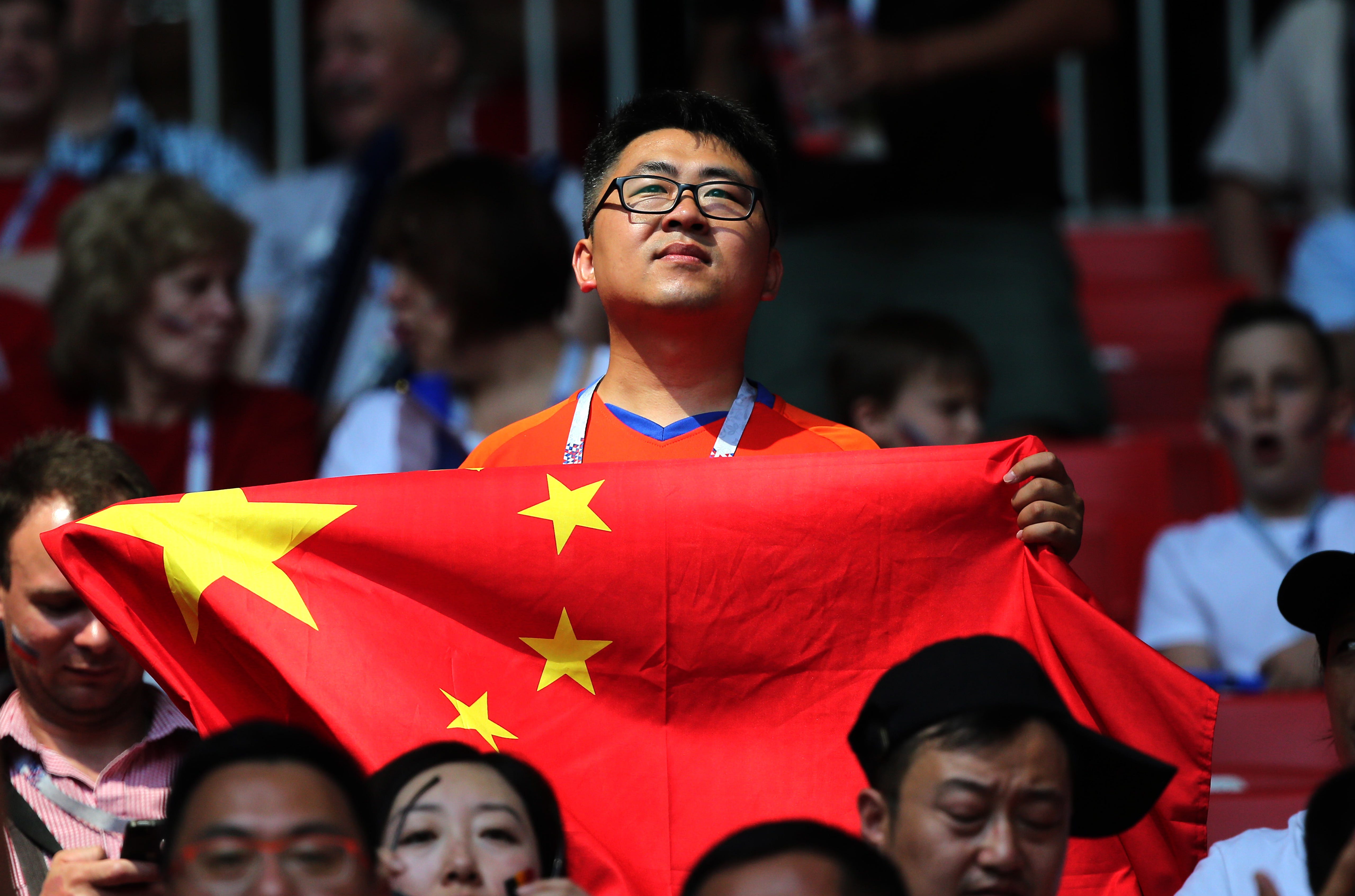
60,000 Chinese fans travelled to Russia in 2018 to attend football's biggest tournament, but this summer many could miss out on the action

FIFA has been struggling to sell its 2026 World Cup broadcasting rights deal in China, in India too.
State broadcaster CCTV normally transmits the tournament but is playing hardball with FIFA over a price for the rights deal, even though football’s global governing body has already reduced the figure it was initially looking for.
Unless a deal is agreed, then screens across the East Asian nation will be blank although Chinese citizens are often highly adept at finding other ways to watch sport on their phones, tablets and laptops.
Cynics might quip that China being unable to watch the World Cup doesn’t really matter as it isn’t a football nation.
Indeed, it is now 24 years since China’s first and only appearance in the men’s tournament, the team making a rapid exit from the 2002 edition following defeat in all three of its matches and nine goals conceded.
Back in 1998, the Chinese men’s national team reached an historic high of 37th in FIFA’s rankings, though its current standing of 94th is more consistent with where the team has performed since then – it isn’t even among the top ten Asian teams according to the latest rankings.
In attempts to engage with global game, ten years ago Chinese government embarked upon a programme of investment and development which the country’s president claimed would see the country become a leading FIFA nation by 2050 – perhaps lifting the trophy, though certainly staging the men’s World Cup tournament.
Even as Covid spread towards the end of 2019, officials were adamant that the country might host FIFA’s showcase in 2030, resulting in an early stage Covid announcement in 2020 that the world’s biggest football stadium was about to be built in Guangzhou.
Yet even at that time, it was becoming clear that China’s football revolution was stumbling, something not helped by the country’s late emergence from pandemic restrictions, global geopolitical turbulence and recurrent governance problems in the nation’s domestic game.
For a long time, then, it has perhaps seemed that China neither wants to watch or fall in love with football.
Which brings us back to this summer’s tournament, who in China will care if the World Cup isn’t on TV?
Actually, there will be plenty of people who will be very upset if they can’t watch.
Afterall, at the 2018 World Cup in Russia, 60,000 Chinese people travelled to watched games (this compares with only 15,000 English fans who were there to follow their national team’s passage to the semi-finals).
Despite China’s Covid restrictions still being in place when the Qatar World Cup took place in 2022, it is estimated that 7,000 Chinese fans still managed to attend.
There’s also undoubtedly a significant level of Chinese interest in football, although figures are often exaggerated by over optimistic observers.
Even so, it is commonly held that there could be 300 million football fans in China, with perhaps as many as 36 million people who characterise themselves as die-hard fans.
Whilst it has been reported that around 510 million people in China watched the 2022 FIFA World Cup overall across TV and digital platforms.
Recent performances show also that Chinese national teams are improving, most recently illustrated by both the men’s and women’s teams reaching the final stages of the under-17 Asian Cup, which would qualify them for the World Cup in these age categories.
At the same time, aspects of the Chinese domestic game are beginning to flourish, in exactly the way that government first envisaged ten years ago.
Jiangsu province’s Su Super League has become a sporting and cultural phenomena attracting significant match attendances whilst becoming a viral social media sensation.
And whilst China’s national team will be staying at home this summer, the country will provide the second biggest contingent of FIFA sponsors (after the U.S.).
Meantime, it remains to be seen how many Chinese fans will make their way to the U.S. to attend matches, but no doubt some will be very keen to do so.
Suffice to say that in one way or another China will be watching this summer’s World Cup, a tournament that is just as much a staple for Chinese fans there as it is for fans elsewhere around the world.